Continue to Write A Story In The Exhibition Hall
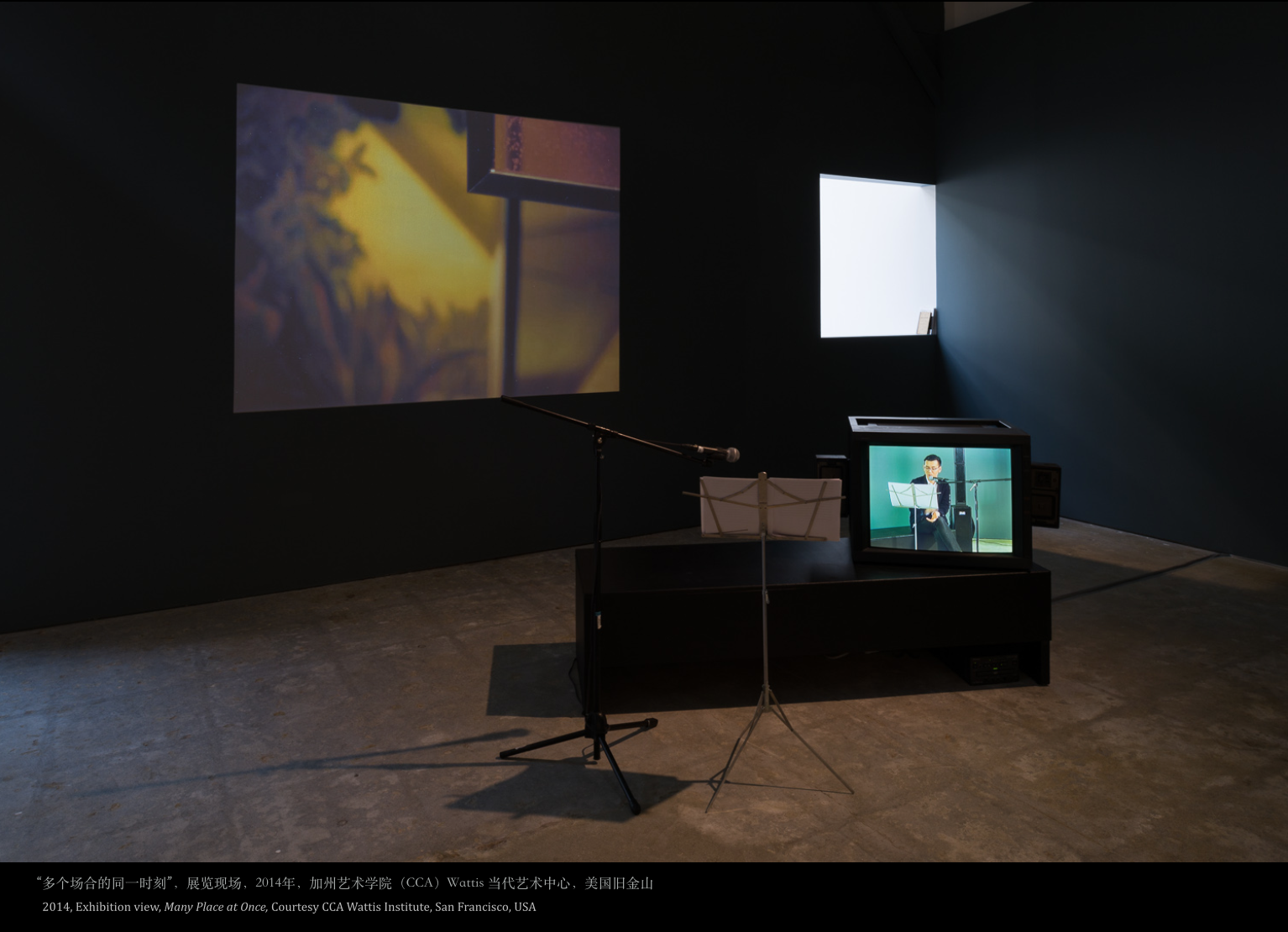
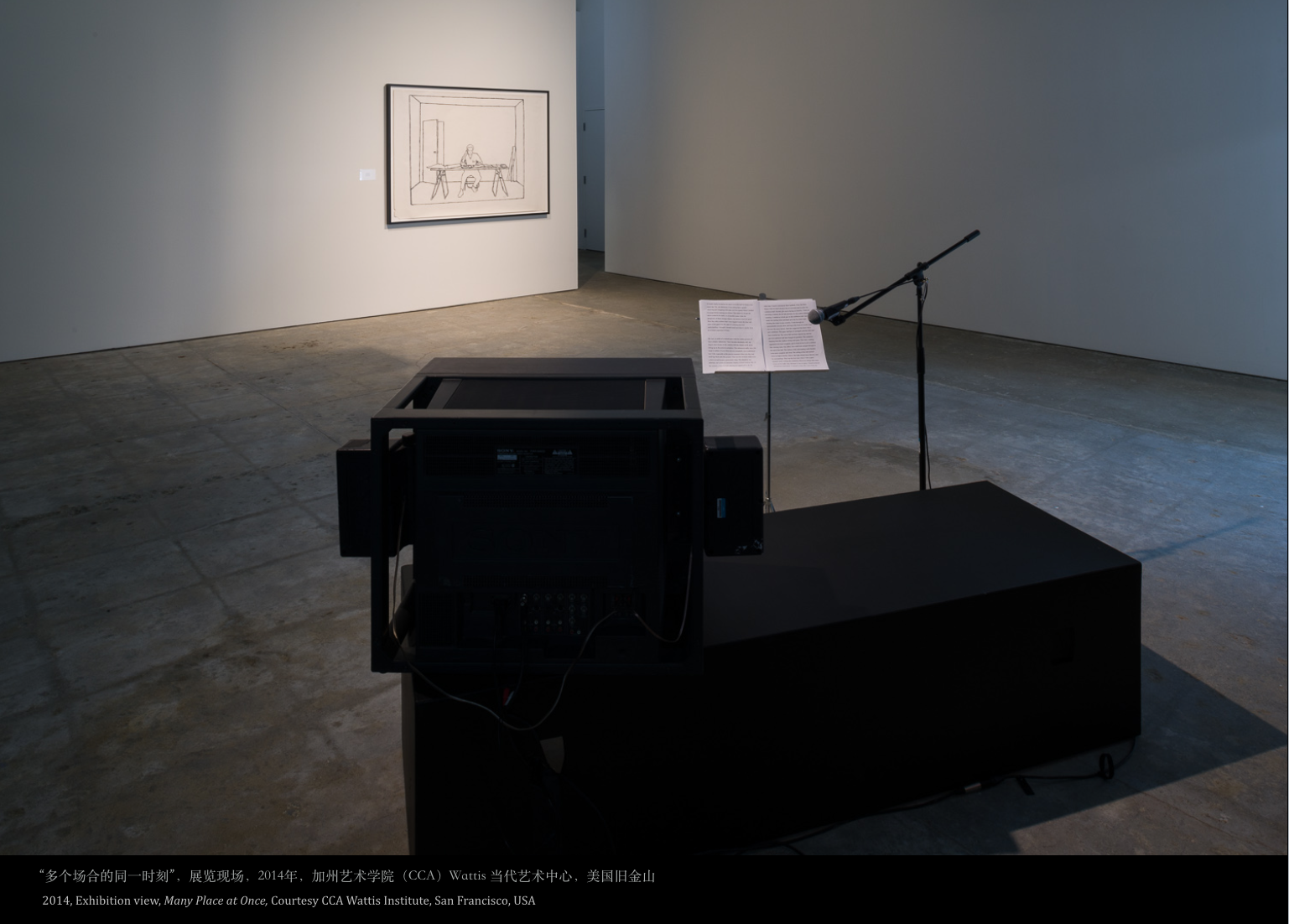
2014, Live Performance & Video Installation, Monitor, Bench, Projection, Microphone, Loudspeaker Box, Variable Size
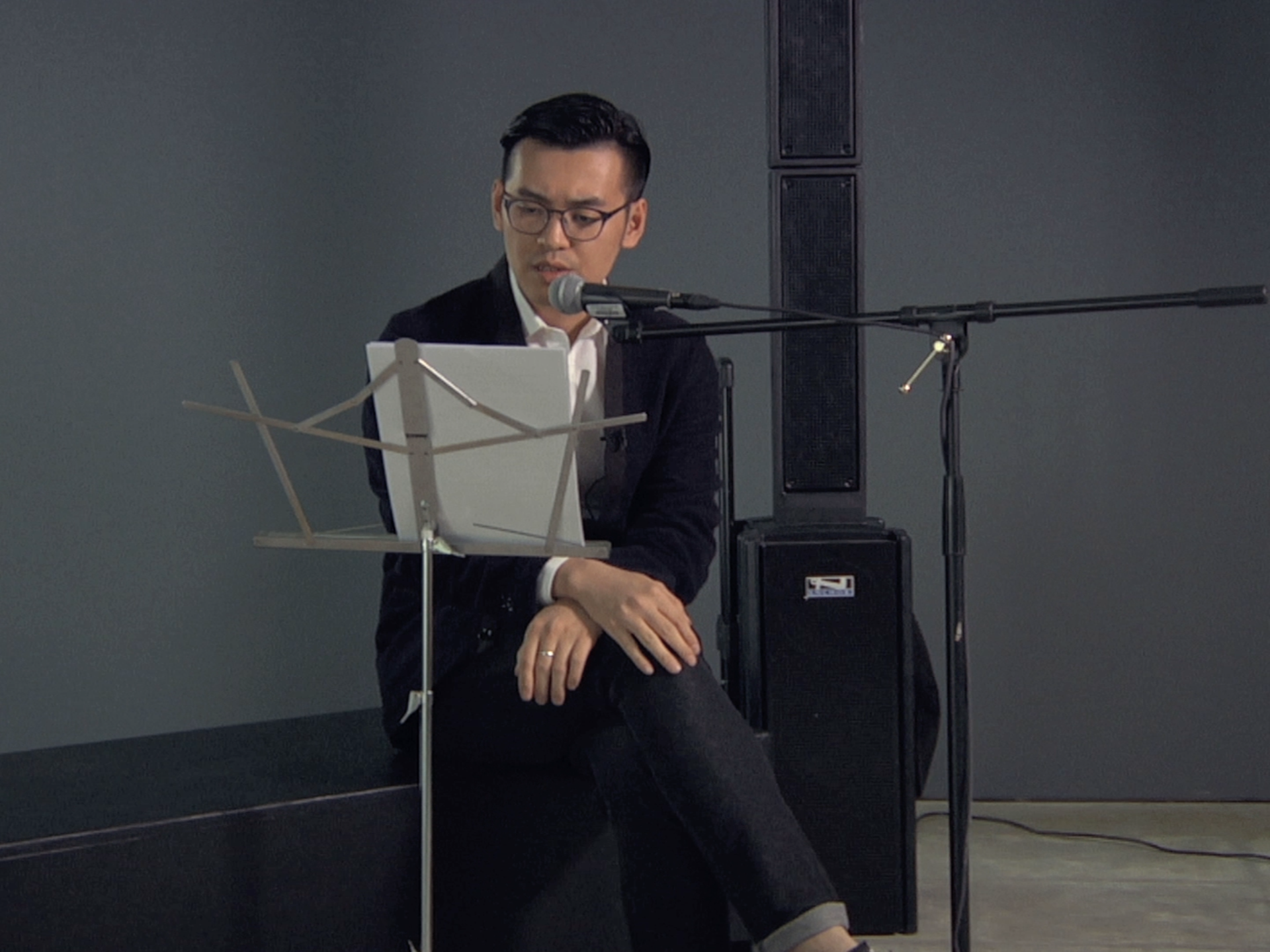
《续写一则展厅中的故事》(录像截图)
2014年,现场表演,录像装置,监视器,长凳,谱架,麦克风,音箱,18分45秒,尺寸可变
《续写一则展厅中的故事》
记得有一天,我起的很早,当时天气不错,吃完早餐之后,我又一个人钻进了美术馆,和往常一样选择了左手边的方向,顺时针的进入展厅,唯一不同的是,我选择尽可能的退远去观看整个展厅和作品之间的关系。这些作品显然以各种姿态的摆在美术馆里,或亲近窗户,又或悬挂在弧顶周围。垂落的钢丝好像救生索,崩的笔直;背景的落地窗与弧顶的天窗引散而来的自然光恰到好处,这些光源被收纳进了美术馆,将一楼大厅的几件金属雕塑营造的非常温和,这种光亮并不刺眼,但轮廓清晰,好像是经历某种漫长的等待才到达这个时空,顺着溜白的展墙一直到蜡黄的水泥自流平地面,温存着每一丝光照的温度。
要是在展厅里坐上几个小时,或者一整天,显然是不明智的,但是在有天下午,我就坐在那里,静静的观摩,和时间搏斗,像一种游戏,必须从某一时间的限定中逃离出来,这种欲求逃跑的动作往往是静止的,也或者对于这些奇怪的物件来说,我的做动作太快,它们是否能察觉我正处在这个凝视的时空当中呢?为了考证我的所能理解的,我想应该站在另一个翻转的时空当中惊醒观看,我的眼神以及所有细微举止在与这些现代魅影的对视当中变成绝对的静止,我的手指也卡在了相机的B门上,僵持着,保持在一个永不松懈的动作过程中。这个下午的确有些难熬,如果你经常在跑步机上跑步,你就会知道我感受,特别是当你把疲惫的双腿溜向地面的那一刻,此时的一瞬间变得尤为漫长,这个漫长绝对不是一种影像速率上的慢放,而是与之相反的快进,2倍、4倍、甚至8倍速的快放。
我知道我不太可能每天都去展厅,所以大部分时候我会携带相机,记事本,这些能帮助我回放记忆和再整理的工具是必不可少的,以前选择进暗房自已动手冲洗这些照片,当然现在可能不需要的了,其实暗房和展厅是截然不同的两种空间,却是一种极为相似的载体。在暗房中每一个步骤必须按部就班,一点点差错都不能有,不然就会前功尽弃。暗房里每一样小工具都必须事先安放规整,需要绝对性的记住每一样物品所摆放的位置,一上手就不能有差错,牢记那些例如顺时针方向转动3圈、逆时针转动两次之类的定律,在没有定时器的情况下,必须心算时间,嘴里要数1、2、3、4一直到20,然后再接下一个动作。
这种经验我曾在展厅中尝试过,因此,我又想起曾经的某一天,我又钻进展厅当中,我尝试着用这种特别的经验来进入展厅观看作品。首先是选择一种观看顺序,抛开导览,虽然一直以来我从没真正看懂过这些导览手册,但是我主观的选择放弃这种依赖。那么,我可以大致看到两条清晰的观看路线,暂且我把它们称为左通道和右通道,因为他们并不是绝对的左和右,但它意味这一种模糊的顺时针和逆时针运动。所以为了打破某种惯例,我首先排除了顺时针方式,“万恶”的顺时针,几乎所有的法则都顺应了这种顺时针的方式,为了不让自己不会成为机械钟表其中的一枚指针,我选择了右通道,这个时候我几乎把大部分精力都放在了自己身上,我突然觉得美术馆的所谓神圣感在这一刻被短暂隔离了,但是下一个动作意味我将以一种什么样运动姿势完成这一轨迹,所以是左脚先还是右脚先,行走观看的时候是把头先扭向左边还先扭向右边,这些都成为了我的一个困扰,当我选随机而行的时候,感觉就好像一辆右驾驶的日本本地制造的汽车,直接空投到了1号公路上,为了不撞车选择在公路的右车道行驶,并且用左手来操作变速杆,为保证这种步调首先需要放弃的就是观看两旁的风景,所以当我心中从1默数到20的时候,我就放弃了。
但是对于这种方式,我并不是只尝试过一次,刚才所说的是头一次,最后一次尝试是在某个周六,展厅里多了许多观众,大概是平时的两到三倍,当我在继续用这种愚蠢的逆时针方式进入右通道进行观看的时候,我居然从1数到了40,而这次打断我继续观看的是这些周六才会来的观众,而我极为规范整齐的迈着步伐前进的时候,我被一张张正面袭来的脸所惊吓住了,正如我现在也不太敢抬头看你们一样。所以当时我就选择把注意力发在展厅中陈列物上,但是不幸的是,这些作品周围多出几倍数量的后脑勺,我只能从这些背影的缝隙中隐约看到某些局部。
在此之后,我试图总结这些方法。首先最基本的事情是一定要选择观众较少的一个时间进入展厅;第二,放弃对路线的选择;第三,不带相机,不拍照。所以在一个轻松的早晨,我迈着轻快的步伐来到了展厅,和往常一样,面带微笑的售票小姐撕下一张票据给我,领着这张票路过保安,再穿过一道可有可无的安检门,来到了一件作品面前,这件作品我之前没见过,那么这就意味着这是一个新的展览,空间被从新组织过,墙也是新刷过的,大厅整个被打通了,之前有的隔墙变换了位置,弧顶一处的悬挂的雕塑不见了,这个时候弧顶变得更完整了,而在我前方的并不是一个通道状观看路线,而是一眼就可以看到底的展厅,四周的墙体轮廓更加完整和清晰,整个展厅的空高似乎高出的一倍, 光线更加方正的投射到了四周,这一刻的宁静是我观展以来头一次感受到,但糟心的事情像是永远不会停止,正因为这般的安静,我听到了某处有人在窃窃私语,我本想在我脑海中抹掉这个声音,但是好奇心又驱使我聆听这个声音,跟踪这个声音的来源。跟踪是一种本能,就在我的右前方三个亚洲男孩,一边小声的说话,一边朝我的方向走来,迫使我的注意力被他们吸引过去,我本能的开始猜想他们的国籍……
——文段摘自剧本《续写一则展厅中的故事》
Continue To Write A Story In The Exhibition Hall
There was a day, I recall, when I got up very early. The weather was good. After eating breakfast, I went to the museum alone. As usual, I chose the left-hand side, entering clockwise into the hall. The only difference was that I chose to stand back as far as possible to observe the relationship between the works and the exhibition space itself. These works were clearly placed in various positions in the museum: close to the windows or hanging along the vaulted ceiling. The vertical steel hanging wires looked like safetywires, taut and straight. The floor-to-ceiling windows in the background and vaulted skylights gathered just the right amount of natural light, collecting them inside the museum and creating a warm, harmonious tone among the metal sculptures in the first floor lobby. This kind of light was not harsh to the eye, yet it showcased the silhouettes as if one had been waiting for a long time to arrive at this very moment. Along the smooth white exhibition walls and waxen yellow cement floor, this gentle light preserved every silken strand of radiated warmth.
It would clearly be unwise for one to sit in the hall for hours or an entire day. Yet, one afternoon, I was sitting there, quietly observing and struggling with time, as if in a game where I needed to escape before running out of time. This desire to escape the action tended to be static, or, in another sense, from the perspective of these strange objects, my actions were too quick. Were they able to detect that I was trapped inside this time and space of the gaze? For the sake of verifying my own understanding, I thought I should stand and observe alertly from an inverted experience of time.
My eyes, in midst of a mutual gaze with the subtle gestures of these modern “phantoms,” have become absolutely still, my fingers were frozen on the camera with the shutter on B, never letting up on the action in progress. This afternoon really was a bit tough to endure. If you often run on a treadmill, you would know how I felt, especially at the precise moment when you slip your tired legs back onto the ground. That was the moment when even a short second became particularly long. This duration was definitely not a kind of cinematic display of slow motion, but, on the contrary, a fast forward, playing at a speed of 2x, 4x, 8x.
I knew going to the exhibition everyday would be unlikely, so, most of the time, I would carry my camera and notepad. These tools that would help me to play back and edit my memories were essential. I used to choose to develop photographs in the darkroom. Of course, now, that is probably no longer necessary. In fact, darkroom and exhibition are two entirely different spaces, but yet they are very similar. In the darkroom, each step must follow an overall sequence; there is no room for even the smallest mistake. Otherwise, everything done before would be in vain. In the darkroom, every instrument must be placed neatly in advance, and one needs to remember the absolute placement of each item. There cannot be any room for mistakes once the process begins. One must keep in mind rules such as “three rotations clockwise and two rotations counterclockwise”to develop a photograph. If a timer is not available, one must keep time in his head, and the mouth has count 1,2,3,4 to 20 followed by the next step.
I have experienced something similar in the exhibition hall. So I thought of yet another day when I went again into the exhibition hall. I tried using this special experience (from the darkroom) to enter the hall to see the works. First I chose an order of seeing, putting aside the guide to the exhibition. Even though I had never really understood these guidebooks, I intentionally chose to give up this dependency on the guide. I could almost see two clear viewing lines. For the time being, I refer to these lines of sight as the left and right corridors because they are not left and right in the absolute sense. up this dependency on the guide. up this dependency on the guide. I could almost see two clear viewing lines. For the time being, I refer to these lines of sight as the left and right corridors because they are not left and right in the absolute sense. They refer to a vague clockwise and counterclockwise motion of the body in the gallery space. Therefore, in order to break some kind of convention, I first ruled out a clockwise manner, –from the left to the right side of the room,– the “evil” clockwise direction. Almost all rules conform to the clockwise direction. So as not to become a rotating hand in a mechanical clock, I chose to start by walking through the right corridor. At this time, I put most of my energy on my body. I suddenly felt the so-called sacred quality of the art museum cut short and isolated at this moment, but the next step gave me a sense of what kind of physical movement to accomplish to this trajectory. To use the left or right foot first, or to turn my head towards the left of the right while walking, became a predicament for me. When I chose to go with whatever came up, I felt like a right-hand drive cars manufactured locally in Japan that had been dropped directly onto the Highway 1. In order not to crash, I chose the right lane on the highway and operated the gear lever with the left hand. Ensuring a smooth course required giving up the scenery on both sides, so after I silently counted my heartbeats, from 1 to 20, I gave up.
Yet, I did not try using this approach just this once. What I just described was the first time. The last time was on a certain Saturday when there was a large crowd in the exhibition hall–about two or three times the size of the usual crowd. When I continued to use this rather clumsy counter-clockwise approach to enter the hall through the corridor s.on the right side, I actually counted from 1 to 40. This was the Saturday audience that disrupted my continual observation. And when I marched forth in my extremely neat steps in regular pace, I was shocked by the faces coming straight at me one by one, just as I do not dare to raise my head and look straight at you right now. So, at that time, I chose to focus on the objects displayed in the exhibition hall. But, unfortunately, these works were surrounded by even more people’ backs-of-heads. I could only see vague bits and pieces from the gaps between their silhouettes.
After that, I tried to summarize these methods. First, the basic thing is that we must choose a not-so-crowded time to enter the exhibition hall. Second, give up on having an itinerary. Third, do not bring a camera; do not take pictures. So on a rather relaxed morning, I walked at a brisk pace to the exhibition hall. And as usual, the smiling ticket attendant gave me my ticket stub. Holding this ticket to pass security, I went through an unremarkable security door, arriving at the front of a work. I had not seen this piece before–then this suggested that there was a new exhibition. The space had been re-arranged, and the walls had been touched up. The whole hall had been opened up, and the previous partition wall had changed its position. The sculptures hanging from the vaulted ceiling were gone. This time, vaulting appeared even more complete, and in front of me is not a corridor-like viewing route, but, rather, one could look straight through to the end of the hall. The outline of the surrounding walls became even more complete and clear. The ceiling of the hall seemed twice as high as before. Above, the light shined more directly onto its surroundings. This was the first time where I felt a quiet moment while visiting the exhibition. However, things that cause worry never really stop. Because it was so quiet, I heard someone whispering somewhere. I wanted to erase this voice from my head, but curiosity had driven me to listen to this voice, tracking the source of the sound……
( The selected text from Li Ran’s performance script “Continue To Write A Story In the Exhibition Hall”)